Tag Archive for 'Marsha Norman'

John Weidman Introduction to Theresa Rebeck

Playwright John Weidman introduced Theresa Rebeck for the Laura Pels Keynote address at an ART/NY event in NYC.  Here’s the intro:

Theresa Rebeck and I have been friends for a very long time, and one of the first things I learned about her was also one of the most important.  When she has something to say the best thing to do is just get out of the way.

Which is what I plan to do tonight.

First, however, there are a couple of things I want to say about Theresa:

A number of years ago, somebody asked George S. Kaufman what it was like to write a play.  He said it was easy.  You simply sat down in front of a blank piece of paper and stared at it until blood began to seep through your forehead.  From my point of view, an entirely accurate description.

But what about from Theresa’s?

Since she graduated first from Notre Dame, then from Brandeis—a religious mystery I still can’t quite sort out—Theresa has produced a body of work the breadth and variety of which is genuinely breathtaking.

16 full-length plays, 23 one acts, 3 produced screenplays, 2 published novels, a book of essays, between 25 and 40 episodes of prime time television shows like L.A. Law, NYPD Blue, and Law & Order, along with a grab bag of pilot scripts, treatments, unfinished or abandoned plays, Christmas lists, to-do lists, grocery lists, and a list of people who really piss her off—a list which, believe me, you do not want to be on. Continue reading ‘John Weidman Introduction to Theresa Rebeck’

  • Share/Bookmark
Tags: Diana Son, Kia Corthron, Marsha Norman, Theresa Rebeck

Playwright Marsha Norman Talks About Gender Inequity in the Theatre

MarshaNormanMarsha Norman is one of our best known female playwrights.  Her play ‘night Mother won a Pulitzer Prize in 1983, and she has also written the book for the musicals The Secret Garden and The Color Purple.

She recently went out on a limb and talked about the gender inequity in the theatre world.  This piece, Not There Yet, was published in American Theatre and is now online and must be read.

It takes a lot of guts to stand up and call a spade a spade.  While this piece might just be about theatre in particular, it reflects the wider problem.  Norman challenges the literary departments, the artistic directors, the funders, the critics, the newspapers who employ the critics and the writers themselves to do things differently, to think about this as a crisis, to make change before things get even worse.

Here’s her challenge to women writers:

As women writers, we must demand the best of ourselves. We must travel and learn and listen. And then we must claim our place on the American stage. We have to be more aggressive in this regard and help each other more than we have, and not just side with the boys because we expect them to win.

I love her call to claim our place on the American stage.

Here are some choice quotes (I could quote the whole piece it’s that good):

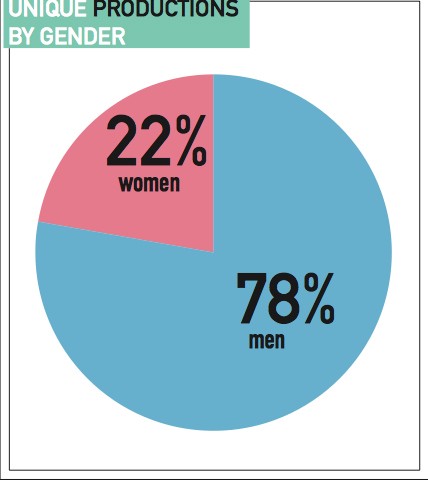
Discussing the status of women in the theatre feels a little like debating global warming. I mean, why are we still having this discussion? According to a report issued seven years ago by the New York State Council on the Arts, 83 percent of produced plays are written by men—a statistic that, by all indications, remains unchanged. Nobody doubts that the North Pole is melting, either—we see it on the news. These are both looming disasters produced by lazy behavior that nobody bothered to stop. End of discussion. What we have to do in both cases is commit to change before it is too late.

We have a fairness problem, and we have to fix it now. If it goes on like this, women will either quit writing plays, all start using pseudonyms, or move to musicals and TV, where the bias against women’s work is not so pervasive.

This past season, theatres around the country did six plays by men for every one by a woman, and a lot of theatres did no work by women at all, and haven’t for years. And as the writing has disappeared, so have roles for actresses and jobs for costume designers and directors. It doesn’t take an economist to draw a conclusion here. Either women can’t write, or there is some serious resistance to producing the work of women on the American stage.

The problem is not that women can’t write. (my bold)

This is my favorite part:

This brings us to the final group that has been blamed for the underrepresentation of women in the theatre—the playwrights themselves. Women’s plays are boring, people say. They have too much talk and there’s no event. They choose “soft” subjects and aren’t aggressive enough about promoting themselves and their work.

The critics have liked my “guy” plays—the ones with guns in them—and pretty much trashed the rest. Seven of the nine plays I have written go virtually unperformed. Thank God I had the sense to write for television and film and write books for big musicals, so I could get health insurance, feed my family and can now afford to teach.

Are those other seven plays of mine worse than Getting Out and ‘night, Mother? Well, how would you know? You haven’t seen them. They are perceived to be “girl plays,” concerned with loss and death, love and betrayal, friendship and family. But no guns.

Are you with me here? There’s no such thing as a girl play. But the girl’s name on the cover of the script leads the reader to expect a certain “soft” kind of play. I don’t get this. Lillian Hellman did not write girl plays. Neither did Jean Kerr or Lorraine Hansberry or Mary Chase.

The expectation of soft work from women writers comes from something way more awful in the society—the commercial romantic idea that all female stuff is soft, an advertising idea. Buy these products and you will have soft hair, soft skin and a soft voice. Unfortunately for writers, soft is perceived as playful and decorative and insignificant, not worthy of our time. We don’t like soft in this country—we like hard here. Hard guy stuff, like in guy plays.

The problem is—and I say this having seen what feels like thousands of them—plays by men are not more violent or more active or smarter or raunchier or more tragic or more anything than plays by women. But plays by men are expected to be better even before they are seen, even before they are read—even, yes, before they are written. This is bias, pure and simple. And we also don’t like bias in this country, so it’s time to stop thinking this way. Women’s plays are written by women, that is all.

To me this is the kicker.  “Plays by men are expected to be better.”

Women’s plays, ones that might not conform to the male norm of what a play is supposed to be, are deemed soft or maybe a better word for that is girly or pink.  It’s like the whole issue with the chick flick.  Women’s work, and women in general, are perceived to be “lighter.”  Lots of women do have smaller bodies but that doesn’t mean we are lighter or like pink any better than gray or green.

To me this is the fundamental issue.  How we perceive women’s and men’s experiences.  Why is a man’s experience or opinion any more important than a woman’s?  That my friends is why we fight the feminist fight day in and day out.

Not There Yet (American Theatre)

  • Share/Bookmark
Tags: Lillian Hellman, Lorraine Hansberry, Marsha Norman