London-based director Cosima Spender graduated with a degree in anthropology and art history from the University of London. Since graduating from the National Film and Television School in 2001, she has directed documentaries for the BBC and directed commercial work in the music world. (Tribeca Film Festival)
“Palio” will premiere at the 2015 Tribeca Film Festival on April 18.
W&H: Please give us your description of the film playing.
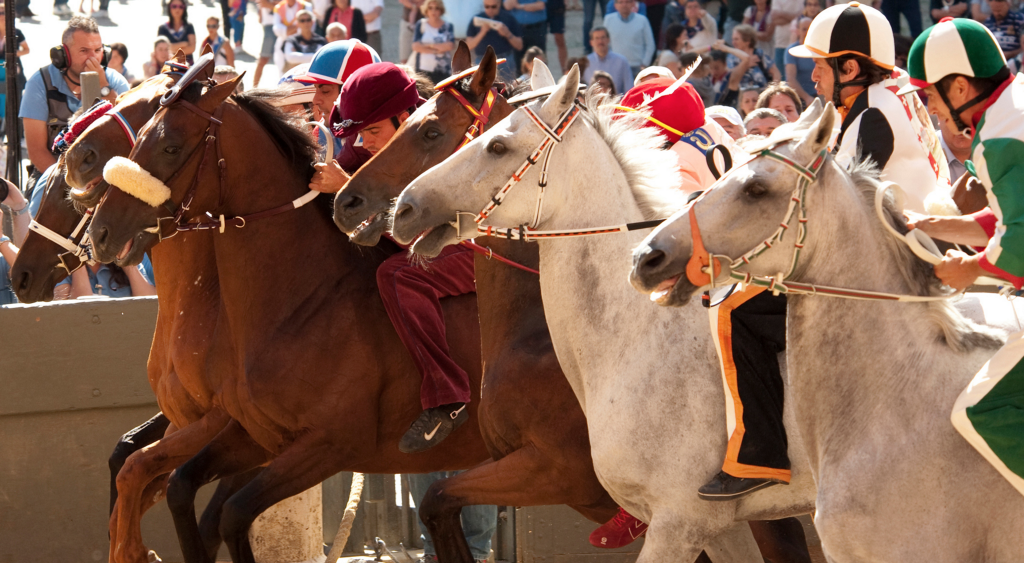
CS: It’s an epic story about a young jockey who challenges his former master in the Palio, the oldest horse race in the world. The Palio is more than a sporting event; it’s a medieval game of strategy, deals and machinations set in the beautiful city of Siena. Nothing is predictable and the rules can be ridiculous — but it is honestly one of the most exhilarating 90 seconds you can witness.
W&H: What drew you to this story?
CS: I studied anthropology and art history, as I have always been captivated by living traditions. I grew up in Siena and was surrounded by the Palio, and all my friends at school were obsessed with it. But since my parents are English, I was never quite part of it.
As a documentarian, I was in a perfect position: I could communicate with all the protagonists in the film while remaining an outsider who could ask intrusive, almost forbidden questions. No one had ever covered the Palio in this kind of detail, because no one was allowed the access. So it is thrilling to bring this story to the world for the first time.
W&H: What was the biggest challenge in making the film?
CS: The biggest challenge was to shoot a story unfolding in the present, with different characters in different places. It was impossible to know what the story of this film was going to be before the race began. I chose to follow the most experienced and successful jockey as well as a younger, less experienced one to capture the hierarchy of power within their world. It turned out to be a lucky choice, as the two of them were classic antagonists. The Palio is shrouded in mystery and secrecy, and the players can’t discuss their devious schemes, so I’ve included two retired older jockeys who act as the chorus in a classic Greek drama: shedding light on the machinations taking place.
In the edit, the challenge was to entice the viewers into a world of arcane intrigues without alienating them with too many facts. Paradoxically, in the field being a woman actually helps you: people often feel more comfortable talking to women, which is key in documentaries. It is up the ladder that being a woman in a position of power is challenging.
W&H: What do you want people to think about when they are leaving the theater?
CS: I would like people to feel that they’ve understood something more about Siena than the usual Palio as seen by tourists. It is full of beauty, romance and tradition, but also power, schemes and bribery. It’s Italy in a nutshell, with all its incredible mixture of beauty and betrayal.
W&H: What advice do you have for other female directors?
CS: Don’t give up! And if children appear, don’t give up on them either. Don’t be intimidated by the fact that it’s a male world.
W&H: What’s the biggest misconception about you and your work?
CS: If something I make succeeds, people say it was luck. But I don’t just throw myself into the unknown. I research my subjects and listen constantly to what the characters have to say. Luck comes into it, but the story is made by them. Documentaries are unpredictable. You never know what will turn up, and the drama occurs in real time. But if you listen to people, a narrative always emerges.
W&H: How did you get your film funded? Share some insights into how you got the film made.
CS: I was talking to a friend in London about my ongoing research on the jockeys of the Palio. Soon after, my friend met a creative entrepreneur, John Hunt, who told him out of the blue, “I’ve always wanted a make a film on the Palio.” It was fate: John financed and produced the film.
W&H: Name your favorite woman-directed film and why.
CS: “Beau Travail” by Claire Denis. If it’s true that it’s a male world, the female view of it is worth more.